
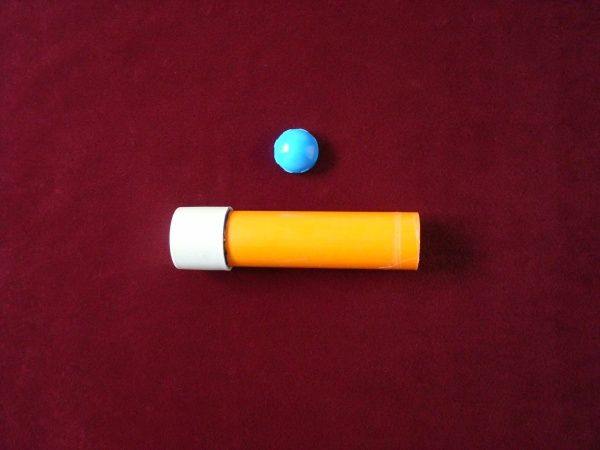
The NTUOET is used for the shallow uranium-ore-body detection through radon- gas monitoring in the soil air above the ore body. It can detect much deeper uranium mineralisation than a scintillometer or airborne gamma spectrometry.
Radium generates radioactive radon gas (²²²Rn) through its radioactive decay in uranium ore. A small fraction of the radon gas escapes from the uranium-bearing minerals and becomes mobile in the pores of the ore body. Radon gas can subsequently diffuse a few metres in pore air above the ore body, depending mainly on moisture content in rock and soil pores. It has been demonstrated that, in dry soil conditions, an elevated radon-activity concentration in the soil air can be due to uranium mineralisation up to 5 m below the surface. Radon can also reach the NTUOET from much deeper ore bodies through transport along faults.
The NTUOET is inserted by the client into a tightly made hole in the soil so that the bottom of the tool is 13 cm below the surface. Soil around the tool is slightly compacted with a hammer. Typically the NTUOET is exposed for 2 – 4 weeks. Within 3 – 5 weeks of exposed NTUOETs being received, RDS e-mails the radon activity concentrations in the soil air (Excel spreadsheet) to the client.